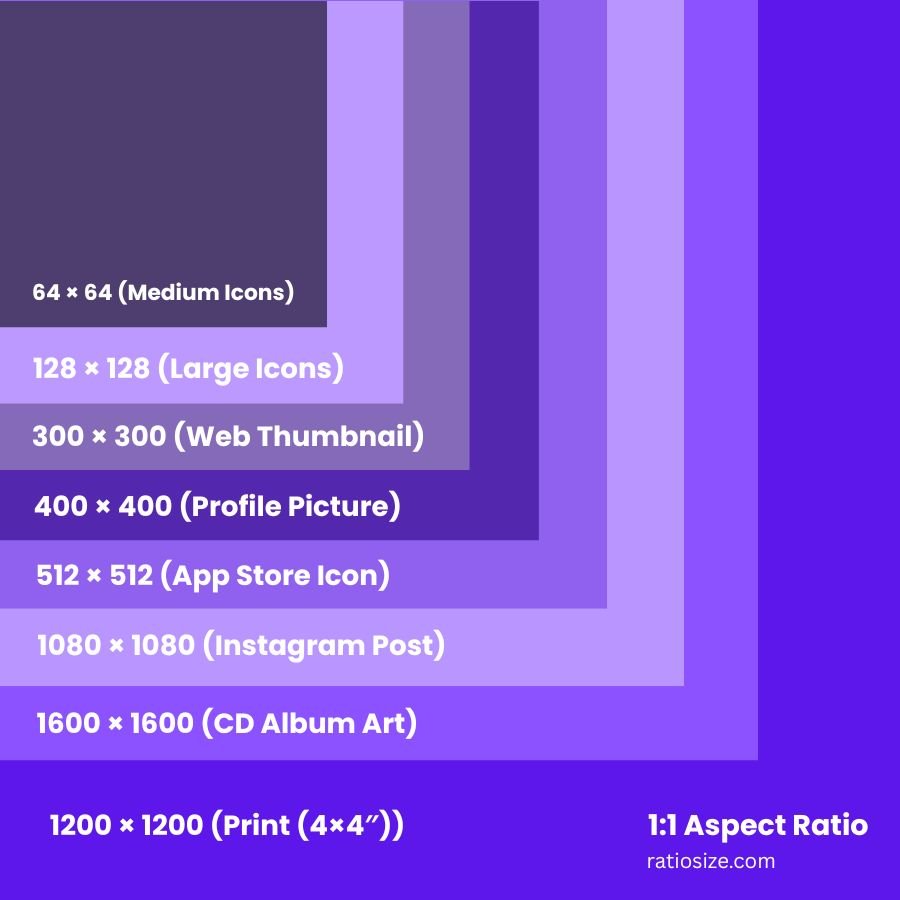
Understanding the 1:1 Aspect Ratio
The 1:1 aspect ratio, or square format, is one of the most straightforward and visually balanced proportions in visual media. This perfect square, where width equals height, has been a fundamental shape in art, design, and photography throughout history. While rectangular formats dominated much of 20th-century visual media, the square has experienced a renaissance in the digital age, largely driven by social media platforms like Instagram.
The mathematical simplicity of the 1:1 ratio translates to a visual simplicity that focuses attention directly on the subject. Without the dynamic tension created by unequal sides, square formats create a sense of stability, symmetry, and completeness that makes them ideal for certain types of content.
Common 1:1 Resolutions and Their Applications
| Usage | Dimensions (pixels) | Total Pixels | Common Applications |
|---|---|---|---|
| Small Icons | 32 × 32 | 1,024 | Favicons, system icons |
| Medium Icons | 64 × 64 | 4,096 | App icons, UI elements |
| Large Icons | 128 × 128 | 16,384 | Desktop icons, dock icons |
| App Store Icon | 512 × 512 | 262,144 | App marketplace listings |
| Profile Picture | 400 × 400 | 160,000 | Social media profiles |
| Instagram Post | 1080 × 1080 | 1,166,400 | Standard Instagram feed posts |
| Web Thumbnail | 300 × 300 | 90,000 | Product images, previews |
| CD Album Art | 1600 × 1600 | 2,560,000 | Digital album covers |
| Print (4×4″) | 1200 × 1200 | 1,440,000 | Small photo prints (300 DPI) |
| Print (8×8″) | 2400 × 2400 | 5,760,000 | Medium photo prints (300 DPI) |
| Print (12×12″) | 3600 × 3600 | 12,960,000 | Large photo prints, vinyl covers (300 DPI) |
Historical Significance of 1:1
The square format has a rich history in visual media, predating digital photography by many decades:
- Traditional photography: Medium format cameras like the iconic Hasselblad (6×6 cm) and Rolleiflex produced square negatives, influencing generations of photographers to compose within this format.
- Album covers: The 12×12 inch vinyl record sleeve became one of the most influential square canvases in popular culture, shaping visual aesthetics in music packaging.
- Art and design: The square has been a fundamental compositional element in various art movements, especially minimalism and geometric abstraction.
- Digital revival: Instagram's initial square-only format (launched in 2010) reintroduced the 1:1 ratio to a new generation, making it a dominant format in social media imagery.
The square format's enduring appeal lies in its perfect symmetry and balance, qualities that have made it a recurring element throughout art history and now in digital media.
1:1 in Social Media
Social media platforms have embraced the square format for various reasons:
- Instagram's influence: Instagram's original square-only format established the 1:1 ratio as the standard for social photo sharing, and even though the platform now supports other ratios, square images remain prevalent.
- Profile pictures: Nearly all social platforms use square or circular (cropped from square) formats for profile pictures and avatars.
- Grid compatibility: Square images create uniform, visually pleasing grids in profile views and feed layouts.
- Cross-platform consistency: Content formatted as 1:1 displays consistently across different platforms without awkward cropping.
Social media tip: When creating content for multiple platforms, the 1:1 format often serves as the most versatile option, allowing for consistent presentation across various feeds without significant cropping or reformatting.
1:1 in Photography and Design
The square format creates unique compositional opportunities and challenges:
- Centered composition: The square naturally draws the eye to the center, making it ideal for subjects that should command immediate attention.
- Symmetry: The equal sides of a square emphasize symmetrical compositions, creating a sense of balance and harmony.
- Radial designs: Circular or radial compositions work particularly well within the square format, as they echo the square's equal dimensions.
- Rule of thirds: The rule of thirds applies differently in square formats, with intersection points closer to the center than in rectangular compositions.
Photographer's tip: When shooting for square output, consider leaving extra space around your subject if using a rectangular viewfinder. This gives you flexibility to create the most effective square crop during post-processing.
Converting Between 1:1 and Other Aspect Ratios
Adapting content to or from the square format requires careful consideration of composition:
Converting from Rectangular to Square
- Centered crop: The simplest approach is to crop from the center, but this often loses important elements at the sides of wide images or the top/bottom of tall images.
- Selective crop: Choose the most important section of the rectangular image to preserve in the square format.
- Padding method: Add equal borders to the shorter sides to create a square without cropping the original image.
Converting from Square to Rectangular
- Extension technique: Expand the canvas on two sides and add complementary elements to fill the new space.
- Background expansion: For images with simpler backgrounds, the background can be extended to fit wider or taller formats.
- Multiple image approach: Use the square as part of a larger rectangular composition, paired with text or additional imagery.
Design consideration: When creating content that might need to appear in multiple aspect ratios, consider a "safe area" approach where key elements remain within the central square portion that will be preserved across all formats.
Technical Considerations for 1:1 Content
File Size and Resolution
The square format has specific implications for file size and storage:
- Equal dimensions: For a given width, square images will contain more pixels than landscape (e.g., 16:9) images but fewer than portrait (e.g., 4:5) images.
- Resolution requirements: For print output, remember that a square inch contains the same number of pixels as any other inch at the same DPI. A 4×4 inch print at 300 DPI requires 1200×1200 pixels.
- Compression considerations: Square images with centered subjects often compress efficiently, as the focal point receives more detail allocation in many compression algorithms.
Display Considerations
When displaying square content on various devices:
- Responsive design: On mobile devices, square images typically display at full width with equal margins above and below.
- Print layout: Square images require special consideration in layout design, as they don't conform to standard paper sizes without trimming or borders.
- Digital frames: Most digital frames and displays are rectangular, meaning square images will display with equal letterboxing on two sides.
Future of the 1:1 Aspect Ratio
The square format's future remains secure for several reasons:
- Established social media standard: The square has become firmly established in digital culture through years of social media prominence.
- Profile imagery: The continued use of square or circular profile pictures ensures the format's relevance.
- Compositional advantages: The unique aesthetic and compositional properties of the square ensure its ongoing role in photography and design.
- Product photography: For e-commerce and product showcases, the square format remains ideal for consistent, organized presentation.
While vertical formats have gained prominence with the rise of Stories and short-form video content, the square remains indispensable for certain applications and continues to offer unique creative possibilities that rectangular formats cannot match.
Practical Applications and Tips
For Photographers
- Use the square format for subjects that benefit from centered composition, like portraits and symmetrical architecture
- Consider how negative space works differently in square formats—it creates a different visual rhythm than in rectangular frames
- Try the "central circle" technique: imagine a circle in the center of your square and place your main subject within it
For Social Media Creators
- Create templates in 1:1 format for consistent branding across different platforms
- When designing square posts with text, keep important text within the central 70% of the square to ensure readability
- Consider how your square posts will appear in a grid view—create visual continuity between adjacent posts
For Graphic Designers
- Use the diagonal lines of a square (corner to corner) as powerful compositional tools
- Explore rotated squares (diamonds) as dynamic elements within square compositions
- Remember that square designs can often be repurposed as circular designs for badges, buttons, and icons
The 1:1 aspect ratio continues to be one of the most versatile and visually balanced formats available to creators. Its perfect symmetry provides a unique canvas that draws focus to the subject while creating a sense of completeness and stability. Whether for social media, photography, album artwork, or product imagery, the square format offers distinctive compositional advantages that ensure its enduring relevance in both digital and print media.