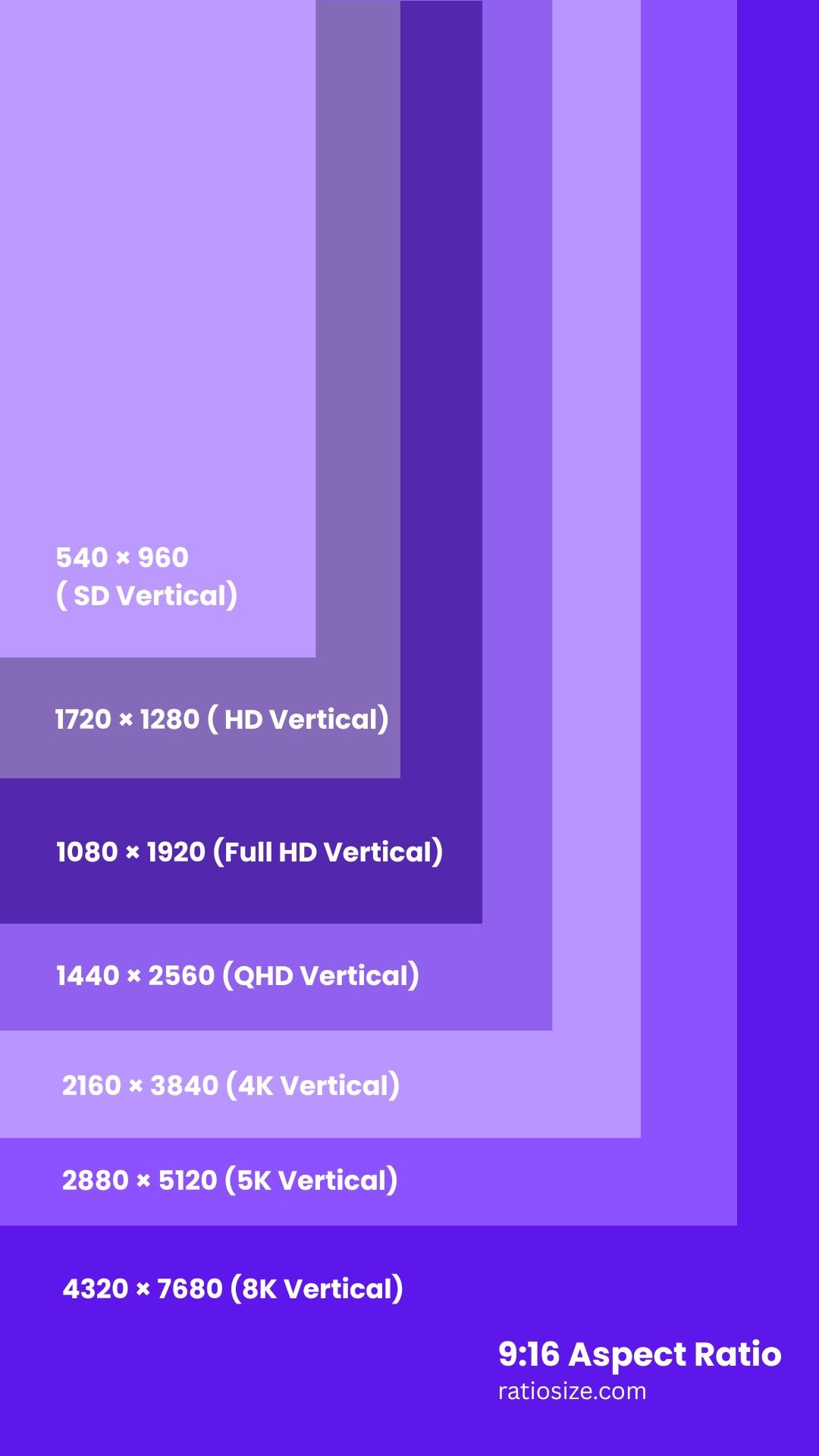
Understanding the 9:16 Aspect Ratio
The 9:16 aspect ratio represents a fundamental shift in how we consume digital content. While horizontal formats dominated screens for decades, the rise of smartphones has made vertical video not just acceptable but often preferable. This portrait orientation (9 units wide by 16 units tall) perfectly matches how people naturally hold their mobile devices, creating a more immersive viewing experience that fills the entire screen.
What was once considered an amateur mistake—shooting video vertically—has evolved into the standard format for many of the most popular social media features and platforms. The 9:16 ratio has become synonymous with Stories, Reels, TikTok, and short-form content designed for mobile-first consumption.
Common 9:16 Resolutions and Their Applications
| Resolution Name | Dimensions (pixels) | Total Pixels | Common Uses |
|---|---|---|---|
| SD Vertical | 540 × 960 | 518,400 | Low-bandwidth streaming, older devices |
| HD Vertical | 720 × 1280 | 921,600 | Standard vertical video, older smartphones |
| Full HD Vertical | 1080 × 1920 | 2,073,600 | Instagram Stories/Reels, TikTok, Snapchat |
| QHD Vertical | 1440 × 2560 | 3,686,400 | Premium content, high-end smartphones |
| 4K Vertical | 2160 × 3840 | 8,294,400 | Professional vertical video, future-proofing |
| 5K Vertical | 2880 × 5120 | 14,745,600 | Ultra-high quality vertical content |
| 8K Vertical | 4320 × 7680 | 33,177,600 | Experimental, extremely high-end applications |
Rise of the 9:16 Format
The vertical video revolution can be traced through several key developments:
- Smartphone adoption: As smartphones became the primary device for content consumption, users naturally held their phones vertically about 94% of the time.
- Snapchat innovation: Snapchat was one of the first major platforms to embrace vertical video as a core feature, normalizing the format for millions of users.
- Instagram Stories: When Instagram launched Stories in 2016, they fully committed to the vertical format, bringing it to a broader audience.
- TikTok explosion: TikTok's massive global success cemented vertical video as the dominant format for short-form content creation.
- Platform adaptation: Eventually, even traditionally horizontal platforms like YouTube introduced vertical formats (YouTube Shorts) to compete in the short-form space.
What was once ridiculed has become the standard, with many content creators now prioritizing vertical formats for their social media strategy. The 9:16 ratio allows viewers to consume content without rotating their devices, resulting in higher engagement and watch times on mobile.
9:16 in Content Creation
For creators, the 9:16 format presents unique opportunities and challenges:
- Compositional focus: The vertical frame forces more intentional composition, often focusing on a single subject rather than wide landscapes or multiple elements.
- Headroom considerations: Proper headroom is crucial in vertical video; subjects need more space above them than in horizontal formats.
- Text and graphics: On-screen text and graphics must be larger and more centered to remain legible on small mobile screens.
- Movement dynamics: Vertical video often works best with vertical movement (up/down) rather than horizontal tracking shots.
Creator's tip: When shooting for 9:16, consider the "vertical rule of thirds"—place key elements along the vertical third lines rather than centering everything. This creates more dynamic compositions while maintaining visibility on mobile screens.
Platform-Specific 9:16 Requirements
While 1080×1920 is the standard across most platforms, there are some specific considerations:
- Instagram Stories: 1080×1920 pixels, with important content kept away from the top and bottom 14% where UI elements may appear.
- Instagram Reels: 1080×1920 pixels, with a central safe area for potential cross-posting to the Instagram feed.
- TikTok: 1080×1920 pixels, with text kept away from the bottom fifth of the screen where captions and controls appear.
- Snapchat: 1080×1920 pixels, with critical content kept within the center 80% of the frame to avoid UI overlays.
- YouTube Shorts: 1080×1920 pixels, with a 9:16 aspect ratio maintained for optimal presentation.
Platform tip: Create templates for each platform that include "safe areas" marking where text and important visual elements should appear to avoid being covered by interface elements.
Converting Between 9:16 and Other Aspect Ratios
Adapting content between vertical and horizontal formats requires careful planning:
Converting from 16:9 to 9:16
- Center crop method: Extract the central portion of the 16:9 frame, losing significant content from the sides.
- Pan and scan: Select and move across the most important parts of the 16:9 frame to create a more dynamic 9:16 crop.
- Background extension: For simpler compositions, extend the background vertically while keeping the subject intact.
- Mathematical conversion: For a 16:9 image with width W, the 9:16 width would be W × (9÷16) × (16÷9), or approximately 0.56W.
Converting from 9:16 to 16:9
- Center crop method: Extract the central portion of the 9:16 frame, losing content from the top and bottom.
- Letterboxing: Place the full 9:16 content within a 16:9 frame with creative backgrounds on the sides.
- Split-screen approach: Use multiple 9:16 clips side by side within a 16:9 frame.
- Mathematical conversion: For a 9:16 image with height H, the 16:9 height would be H × (9÷16) × (16÷9), or approximately 0.56H.
Production tip: When possible, shoot with the final aspect ratio in mind. If cross-platform publishing is required, consider shooting in 4K so you have extra resolution for cropping without quality loss.
Technical Considerations for 9:16 Content
File Size and Bandwidth
Vertical video presents specific technical considerations:
- Equivalent resolution: A 1080×1920 vertical video contains the same number of pixels as a 1920×1080 horizontal video, meaning similar file sizes at the same compression level.
- Compression efficiency: Some compression algorithms were originally optimized for horizontal content and may be slightly less efficient with vertical motion patterns.
- Streaming considerations: Ensure your encoding settings are optimized for mobile delivery, as most 9:16 content is consumed on cellular networks.
Display Considerations
How 9:16 content appears across devices:
- Mobile phones: Perfect fit for most smartphones in portrait orientation.
- Tablets: May display with letterboxing (black bars) on the sides when held in portrait mode, depending on the exact screen ratio.
- Desktop/laptop: Will display with significant pillarboxing (black bars on sides) unless the browser window is resized to a vertical proportion.
- Smart TVs: Will display with extreme pillarboxing, typically using only the center third of the screen.
This wide variance in display conditions reinforces why 9:16 content is primarily designed for mobile consumption.
Future of the 9:16 Aspect Ratio
The vertical format continues to evolve:
- Growing prominence: As mobile consumption increases globally, 9:16 will likely continue to grow in importance.
- Broader adoption: More traditional media outlets are creating vertical versions of their content for social distribution.
- Technical advancement: Camera equipment and editing software are increasingly being designed with vertical video production in mind.
- Advertising shift: Digital advertising is embracing vertical formats to match consumer viewing habits.
- New display technologies: Rotating displays like Samsung's Sero TV suggest future devices may better accommodate switching between aspect ratios.
The 9:16 ratio represents more than just a technical specification—it symbolizes a fundamental shift in how we create and consume digital media, optimized for the devices we use most frequently.
Practical Applications and Tips
For Social Media Creators
- Plan your shots specifically for vertical presentation—don't just crop horizontal footage
- Use the full vertical canvas for dramatic effect, particularly with tall subjects or upward/downward motion
- Keep text large and centered—approximately 30% of screen width is a good guideline for legibility
For Filmmakers
- Consider shooting with anamorphic lenses vertically for a unique look with shallow depth of field
- Practice "vertical cinematography" techniques—many traditional camera movements need rethinking
- Experiment with split-screens and vertical stacking of visual elements
For Mobile Marketers
- Design ad creative specifically for vertical formats rather than adapting horizontal assets
- Front-load important information—users often don't watch the entire vertical video
- Embrace full-screen immersion to capture attention in crowded feeds
The 9:16 aspect ratio has transformed from a technical curiosity to an essential format in the modern content creator's toolkit. By understanding its unique properties and best practices, you can create more engaging vertical content that resonates with today's mobile-first audience. Whether for social media, marketing, or emerging storytelling formats, mastering vertical video opens new creative possibilities in an increasingly mobile-centric world.