Understanding the 2:1 Aspect Ratio
The 2:1 aspect ratio represents one of the cleanest and most mathematically elegant proportions in visual media. This format, where the width is exactly twice the height, creates a panoramic rectangle that naturally draws the eye horizontally across the frame. The simplicity of the 2:1 relationship makes it both aesthetically pleasing and practically useful across a range of applications.
While not as historically prominent as some other aspect ratios, the 2:1 format has gained significance in the digital era. Its expansive horizontal layout provides ample space for landscapes, banners, and wide-format content while maintaining a clean, modern aesthetic. The ratio is particularly effective for subjects and scenes where horizontal breadth is a defining characteristic.
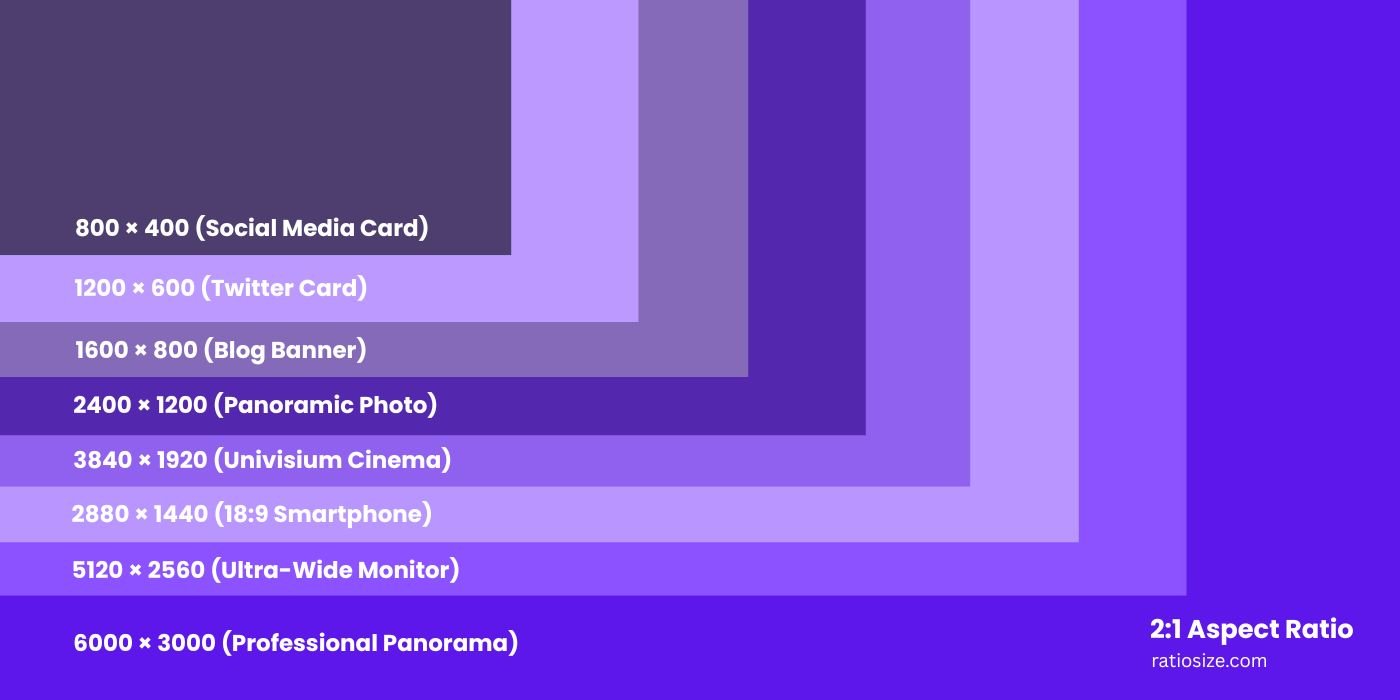
Common 2:1 Resolutions and Their Applications
| Resolution Name | Dimensions (pixels) | Total Pixels | Common Uses |
|---|---|---|---|
| Social Media Card | 800 × 400 | 320,000 | Small social media previews |
| Twitter Card | 1200 × 600 | 720,000 | Twitter posts, LinkedIn articles |
| Blog Banner | 1600 × 800 | 1,280,000 | Blog headers, web banners |
| Panoramic Photo | 2400 × 1200 | 2,880,000 | Landscape photography, wallpapers |
| Univisium Cinema | 3840 × 1920 | 7,372,800 | Digital cinema in 2:1 format |
| 18:9 Smartphone | 2880 × 1440 | 4,147,200 | Modern smartphone displays (marketed as 18:9) |
| Ultra-Wide Monitor | 5120 × 2560 | 13,107,200 | Ultra-wide computer displays |
| Professional Panorama | 6000 × 3000 | 18,000,000 | High-end panoramic photography |
History and Evolution of the 2:1 Format
The 2:1 aspect ratio has several interesting historical touchpoints:
- Early panoramic photography: In the late 19th and early 20th centuries, specialized panoramic cameras captured images with aspect ratios approaching 2:1, though exact standardization was rare.
- Univisium proposal: In the late 1990s, cinematographer Vittorio Storaro proposed the 2:1 "Univisium" format as a universal compromise between theatrical widescreen formats and television displays, arguing it could serve both mediums effectively.
- Twitter cards: When Twitter introduced image cards in 2013, they adopted the 2:1 ratio as their standard format, significantly increasing the format's visibility in digital media.
- Smartphone evolution: Around 2017, smartphone manufacturers began introducing "18:9" displays (which is the same as 2:1), marketing them as more immersive alternatives to the previous 16:9 standard.
- Streaming standardization: Several major streaming series adopted the 2:1 ratio for production, including "House of Cards" and "Stranger Things," helping to establish it as a "premium" digital video format.
This evolution has seen the 2:1 ratio transform from a specialized format to a mainstream option for both content creation and display technology, particularly in digital contexts.
2:1 in Photography and Filmmaking
The 2:1 ratio offers specific creative opportunities in visual media:
- Landscape composition: The wide format naturally accommodates panoramic landscapes, allowing photographers to capture the full breadth of a scene while maintaining a balanced composition.
- Cinematic storytelling: In film, the 2:1 ratio provides ample space for horizontal movement and multi-character framing without the extreme width of anamorphic formats like 2.39:1.
- Negative space utilization: The panoramic frame allows for creative use of negative space, creating tension or emphasizing isolation by placing subjects off-center.
- Balanced movement: For subjects moving horizontally across frame, the 2:1 ratio provides adequate space to show both the subject and their destination or path.
Photographer's tip: When shooting for 2:1 output, consider using leading lines that extend across the full width of the frame to take advantage of the panoramic format's natural ability to draw the eye horizontally.
2:1 in Web Design and Social Media
The 2:1 ratio has become particularly important in digital design:
- Banner design: Website headers and banners often use the 2:1 ratio to create an expansive horizontal space that works well with modern responsive designs.
- Twitter card optimization: Content shared on Twitter displays best when images are prepared in the platform's preferred 2:1 format, improving visibility in feeds.
- LinkedIn articles: Featured images for LinkedIn articles typically display best in a 2:1 format, making this ratio important for professional content marketing.
- Mobile optimization: With many modern smartphones using 18:9 (equivalent to 2:1) displays, content in this format fills these screens perfectly when viewed in landscape orientation.
Design tip: When creating 2:1 banners and headers, place crucial text and visual elements in the central 60% of the frame to ensure they remain visible even if the edges are cropped in responsive layouts.
Converting Between 2:1 and Other Aspect Ratios
Adapting content between 2:1 and other common ratios requires specific approaches:
Converting from 2:1 to 16:9
- Height extension: Add content to the top and bottom of the 2:1 image to fill the slightly taller 16:9 frame.
- Mathematical conversion: For a 2:1 image with height H, the 16:9 height would be H × (9÷16) × (2÷1), or approximately 1.125H.
Converting from 16:9 to 2:1
- Height crop: Remove portions from the top and bottom of the 16:9 image to create the wider 2:1 frame.
- Mathematical conversion: For a 16:9 image with height H, the 2:1 height would be H × (1÷2) × (16÷9), or approximately 0.889H.
Converting from 3:2 to 2:1
- Height crop method: Remove portions from the top and bottom of the 3:2 image to create the wider 2:1 frame.
- Mathematical conversion: For a 3:2 image with height H, the 2:1 height would be H × (1÷2) × (3÷2), or 0.75H.
Conversion tip: When creating content that may need to be adapted between multiple aspect ratios, consider using a central "safe area" that will remain visible across all formats. For 2:1 content, keep critical elements away from the top and bottom edges if conversion to other ratios is anticipated.
Technical Considerations for 2:1 Content
Display Adaptation
How 2:1 content appears across different displays:
- Ultra-wide monitors: Many ultra-wide computer monitors use the 21:9 ratio, which is very close to 2:1, making this content format particularly well-suited to these displays.
- Standard 16:9 displays: On standard widescreen displays, 2:1 content will appear with slight letterboxing (black bars at top and bottom).
- Mobile devices: Modern smartphones with 18:9/2:1 displays will show this content perfectly in landscape orientation.
- Print considerations: The 2:1 ratio doesn't directly correspond to standard print sizes, so content may require adjustment or custom sizing for physical output.
File Size Efficiency
From a technical perspective, 2:1 content offers specific advantages:
- Efficient use of pixels: Compared to wider cinematic formats like 2.39:1, the 2:1 ratio uses more of the available frame, reducing wasted space when letterboxing is required.
- Social media optimization: Platforms like Twitter will display 2:1 images without any cropping or scaling, ensuring your entire image is seen as intended.
- Compression considerations: The clean horizontal lines often found in 2:1 panoramic content can compress efficiently in modern image formats.
Future of the 2:1 Aspect Ratio
The 2:1 ratio's position in contemporary and future visual media:
- Mobile device integration: As 18:9 (2:1) smartphone displays become increasingly common, content in this format will grow in relevance for mobile-first experiences.
- Digital cinema adoption: More filmmakers are choosing the 2:1 ratio as a compromise between traditional widescreen cinema (2.39:1) and television formats (16:9), particularly for streaming-first content.
- Social media permanence: With major platforms like Twitter standardizing on the 2:1 ratio for image cards, this format will remain important for social media optimization.
- Web design evolution: As responsive design becomes more sophisticated, the flexible nature of the 2:1 ratio makes it well-suited for adaptable banner and header designs.
The 2:1 aspect ratio represents a perfect balance of mathematical elegance and practical application. Its clean proportions make calculations straightforward, while its panoramic width offers creative advantages across multiple media formats. As display technology continues to evolve, this ratio's relevance is likely to increase further in both content creation and consumption contexts.
Practical Applications and Tips
For Photographers
- Use the 2:1 ratio for expansive landscapes where the horizontal dimension is the primary compositional element
- Consider how the panoramic format changes compositional rules—traditional rule-of-thirds points are stretched horizontally
- Try shooting a series of images for stitching into a 2:1 panorama if your camera doesn't support this format natively
For Web Designers
- Create site banners and headers in 2:1 format for an expansive, modern look that adapts well to responsive layouts
- Prepare social media share images in 2:1 ratio to optimize appearance on Twitter and LinkedIn
- Place key information in the center 60% of your 2:1 designs to ensure visibility across different devices
For Filmmakers
- Consider 2:1 as a flexible ratio that translates well between theatrical exhibition and streaming platforms
- Use the horizontal expansiveness to create dynamic multi-character compositions
- Explore how the 2:1 frame can be divided into harmonious sections for intentional composition
The 2:1 aspect ratio offers a compelling balance of width and practicality across multiple applications. Its mathematical simplicity—width exactly twice the height—makes it both intuitive to calculate and aesthetically pleasing. Whether for panoramic photography, web design, social media optimization, or modern cinematography, the 2:1 format provides a contemporary, impactful canvas that showcases horizontal subject matter while maintaining compatibility with current display technologies.