Understanding the 3:4 Aspect Ratio
The 3:4 aspect ratio represents a portrait-oriented format that is mathematically the vertical counterpart to the classic 4:3 ratio. With a width that is 75% of its height (or a height that is 133% of its width), this ratio creates a vertically dominant rectangle that feels balanced and natural for portraiture and other vertical subjects.
While often overlooked in discussions that tend to focus on landscape formats, the 3:4 ratio has significant applications across multiple media types. Its proportions align well with human figures, architectural elements, and other tall subjects, providing adequate vertical space without becoming excessively narrow like more extreme portrait ratios.
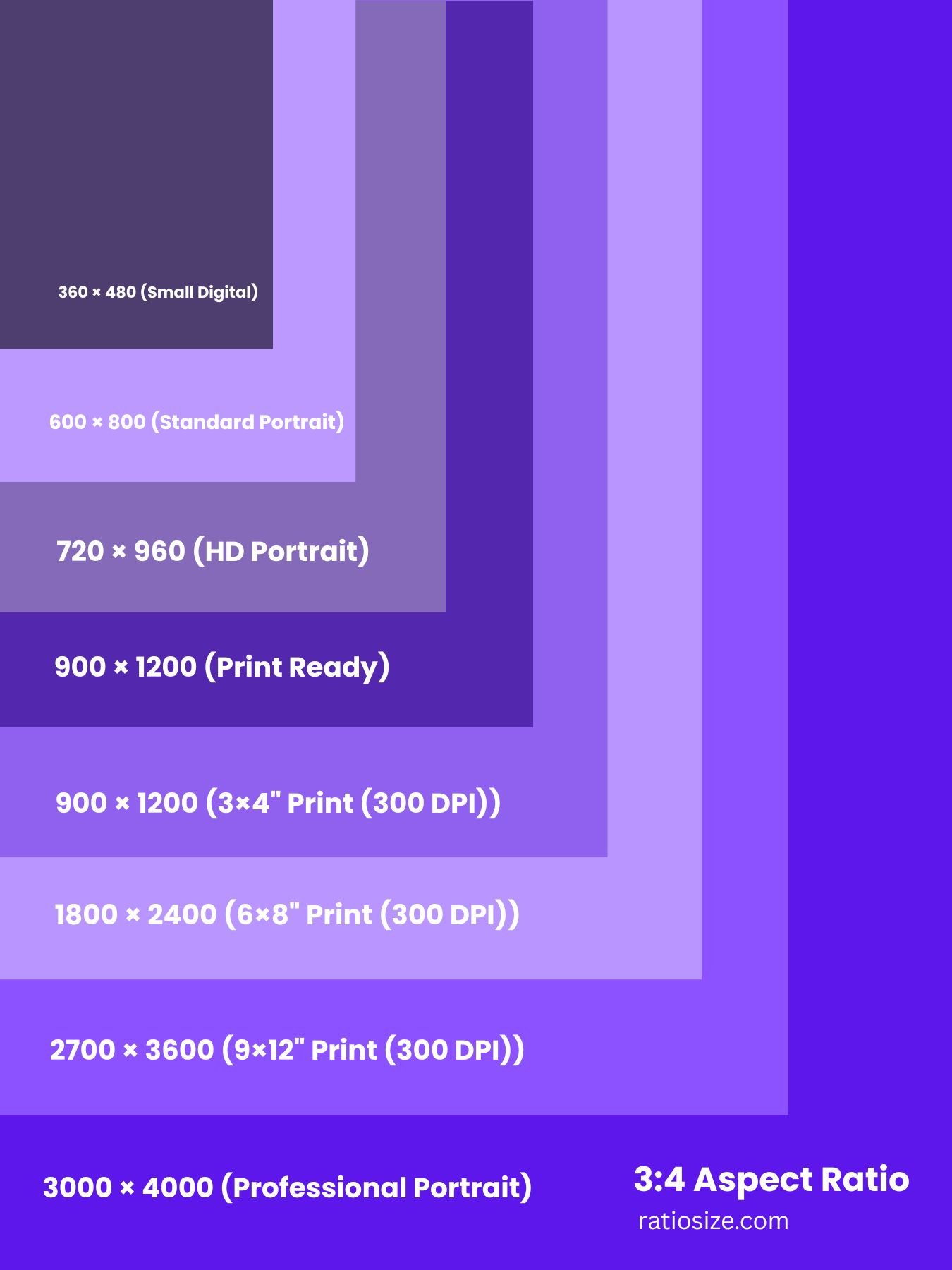
Common 3:4 Resolutions and Their Applications
| Resolution Name | Dimensions (pixels) | Total Pixels | Common Uses |
|---|---|---|---|
| Small Digital | 360 × 480 | 172,800 | Mobile thumbnails, small web images |
| Standard Portrait | 600 × 800 | 480,000 | Digital portraits, web display |
| HD Portrait | 720 × 960 | 691,200 | High-definition portrait format |
| Print Ready | 900 × 1200 | 1,080,000 | Standard photo prints, portfolio images |
| 3×4" Print (300 DPI) | 900 × 1200 | 1,080,000 | Small portrait prints, passport photos |
| 6×8" Print (300 DPI) | 1800 × 2400 | 4,320,000 | Standard portrait photo prints |
| 9×12" Print (300 DPI) | 2700 × 3600 | 9,720,000 | Large portrait prints, display photos |
| Professional Portrait | 3000 × 4000 | 12,000,000 | Professional photography, editorials |
Historical Context of the 3:4 Ratio
The 3:4 aspect ratio has several interesting historical connections:
- Book pages: Traditional book page proportions often approach the 3:4 ratio, which has been a standard in publishing for centuries. This is particularly true for hardcover books and certain classic page layouts.
- Vertical photography: When early photographers turned their 4:3 format cameras to capture vertical subjects, they created 3:4 images. This practice became standard for portrait photography throughout the film era.
- Paper standards: Many traditional paper sizes approximate the 3:4 ratio, including certain variants in the international paper size systems before A4 standardization.
- Early mobile displays: Some early mobile phone displays used the 3:4 ratio before widescreen formats became dominant.
The 3:4 ratio's persistence through technological changes speaks to its natural fit for certain types of content, particularly those focusing on vertical subjects and compositions.
3:4 in Photography and Portraiture
The 3:4 ratio offers specific advantages for portrait and vertical photography:
- Full-length portraits: The vertical emphasis provides adequate space for capturing full-body shots while maintaining a close enough frame to show detail.
- Architectural photography: Buildings and tall structures fit naturally within the 3:4 frame, allowing photographers to capture the full height without excessive empty space on the sides.
- Vertical emphasis: The ratio naturally draws the eye upward through the composition, making it ideal for subjects with strong vertical elements or movement.
- Print compatibility: The 3:4 ratio closely matches several standard photo print sizes, requiring minimal cropping when producing physical prints.
Photographer's tip: When composing in the 3:4 ratio, consider using the vertical rule of thirds to place key elements at the intersection points, creating a balanced but dynamic vertical composition.
3:4 in Print and Publishing
The 3:4 ratio has significant relevance in print media:
- Book pages: Many traditional book formats use pages with proportions close to 3:4, making this ratio important in book design and layout.
- Magazine layouts: Single-page layouts in magazines often work within proportions similar to 3:4, particularly for portrait-oriented content.
- Standard prints: Photo print sizes like 6×8 inches match the 3:4 ratio perfectly, making it a practical choice for physical photography output.
- Posters and displays: Vertical promotional materials often use the 3:4 ratio or similar proportions to maximize vertical display space.
Print consideration: When preparing 3:4 images for print, maintain a 300 DPI resolution for professional quality. For a 6×8 inch print, this means aiming for dimensions of 1800×2400 pixels.
Converting Between 3:4 and Other Aspect Ratios
Adapting content between 3:4 and other common ratios requires specific approaches:
Converting from 3:4 to 4:5
- Vertical crop method: Remove portions from the sides of the 3:4 image to create the narrower 4:5 frame.
- Mathematical conversion: For a 3:4 image with width W, the 4:5 width would be W × (4÷5) × (3÷4), or approximately 0.96W.
Converting from 3:4 to 9:16
- Horizontal crop method: Remove portions from the sides of the 3:4 image to fit the narrower 9:16 frame.
- Mathematical conversion: For a 3:4 image with width W, the 9:16 width would be W × (9÷16) × (3÷4), or approximately 0.42W.
Converting from Landscape Formats to 3:4
- Rotation and crop: For subjects that work in both orientations, consider rotating the composition to vertical and then cropping to 3:4.
- Center crop: For vertically-centered subjects in landscape images, a center crop to 3:4 may preserve the essential composition.
- Content extension: For digital content, consider extending the top and bottom of the image to reach 3:4 proportions without losing side content.
Design consideration: When creating content that may need to be adapted between multiple aspect ratios, consider establishing a "safe area" that will remain visible across formats, keeping crucial elements within this zone.
Technical Considerations for 3:4 Content
Digital Display Adaptation
How 3:4 content appears across different displays:
- Mobile devices: Most smartphones display 3:4 content with minimal letterboxing when held in portrait orientation, making this ratio mobile-friendly.
- Computer monitors: On landscape-oriented monitors, 3:4 content will display with significant pillarboxing (black bars on the sides).
- Print considerations: The 3:4 ratio easily accommodates standard photo print sizes like 6×8 inches without awkward cropping.
- Responsive design: When implementing 3:4 images in responsive web designs, consider how they will reflow on different screen orientations.
File Size and Resolution Considerations
For technical implementation of 3:4 content:
- Vertical reference: Always reference dimensions with width first, even though height is larger in this ratio (e.g., "600×800" rather than "800×600").
- Print resolution: For high-quality physical prints, maintain 300 DPI resolution. A 6×8 inch print requires a 1800×2400 pixel image.
- Comparative pixel count: For a given width, 3:4 content contains 33% more pixels than 3:2 content and 25% more than 4:5 content, affecting file size and memory requirements.
Use Cases and Applications
The 3:4 ratio is particularly well-suited for:
- Portrait photography: The ratio provides ideal framing for three-quarter and full-body portraits, offering adequate headroom and vertical space.
- Book design: For traditional book layouts, the 3:4 ratio or similar proportions create pages with balanced dimensions for reading comfort.
- Mobile-optimized content: Vertical content in 3:4 displays well on mobile devices held in portrait orientation, using screen space efficiently.
- Architecture photography: Tall buildings and vertical structures can be captured effectively in the 3:4 frame.
- Product photography: For tall products like bottles, packages, or clothing, the 3:4 ratio provides appropriate vertical emphasis.
While not as commonly referenced as other aspect ratios, 3:4 offers a versatile portrait format that balances vertical emphasis with practical considerations for both digital and print applications.
Practical Applications and Tips
For Photographers
- Use the 3:4 ratio for portraits where you need to capture more of the body or environment than a tighter 4:5 ratio would allow
- When shooting architecture, the 3:4 ratio provides adequate vertical space for tall buildings while maintaining some context
- Consider the vertical rule of thirds when composing 3:4 images to create dynamic vertical movement
For Print and Publishing
- Prepare 3:4 images at 300 DPI for optimal printing at 6×8, 9×12, and other standard print sizes
- For book page layouts, the 3:4 ratio provides a familiar and readable proportion
- When designing vertical posters or displays, the 3:4 ratio offers more width than extreme vertical formats like 9:16
For Digital Content
- 3:4 content displays efficiently on mobile devices in portrait orientation
- When creating responsive designs, consider how 3:4 images will reflow on different screen sizes
- For presentations that may be viewed on both traditional and widescreen displays, 3:4 content often adapts more gracefully than wider formats
The 3:4 aspect ratio offers a balanced vertical format that works well across multiple applications. As the portrait counterpart to the classic 4:3 ratio, it provides familiar proportions that feel natural for vertical subjects. By understanding its properties and applications, you can effectively leverage this ratio for portrait photography, print publishing, and vertical-oriented digital content.