Understanding the 4:5 Aspect Ratio
The 4:5 aspect ratio represents a vertical rectangle with proportions that strike a balance between square and more extreme vertical formats. With a width that is 80% of its height (or a height that is 125% of its width), this ratio creates a pleasing vertical composition that feels intentional without seeming overly narrow or stretched.
While less historically prominent than some other aspect ratios, the 4:5 format has gained significant relevance in the digital era, particularly through its adoption by Instagram as the maximum vertical extent allowed for feed posts. This technical constraint has turned the 4:5 ratio into a creative standard, influencing how photographers and designers compose vertical content for social media distribution.
Common 4:5 Resolutions and Their Applications
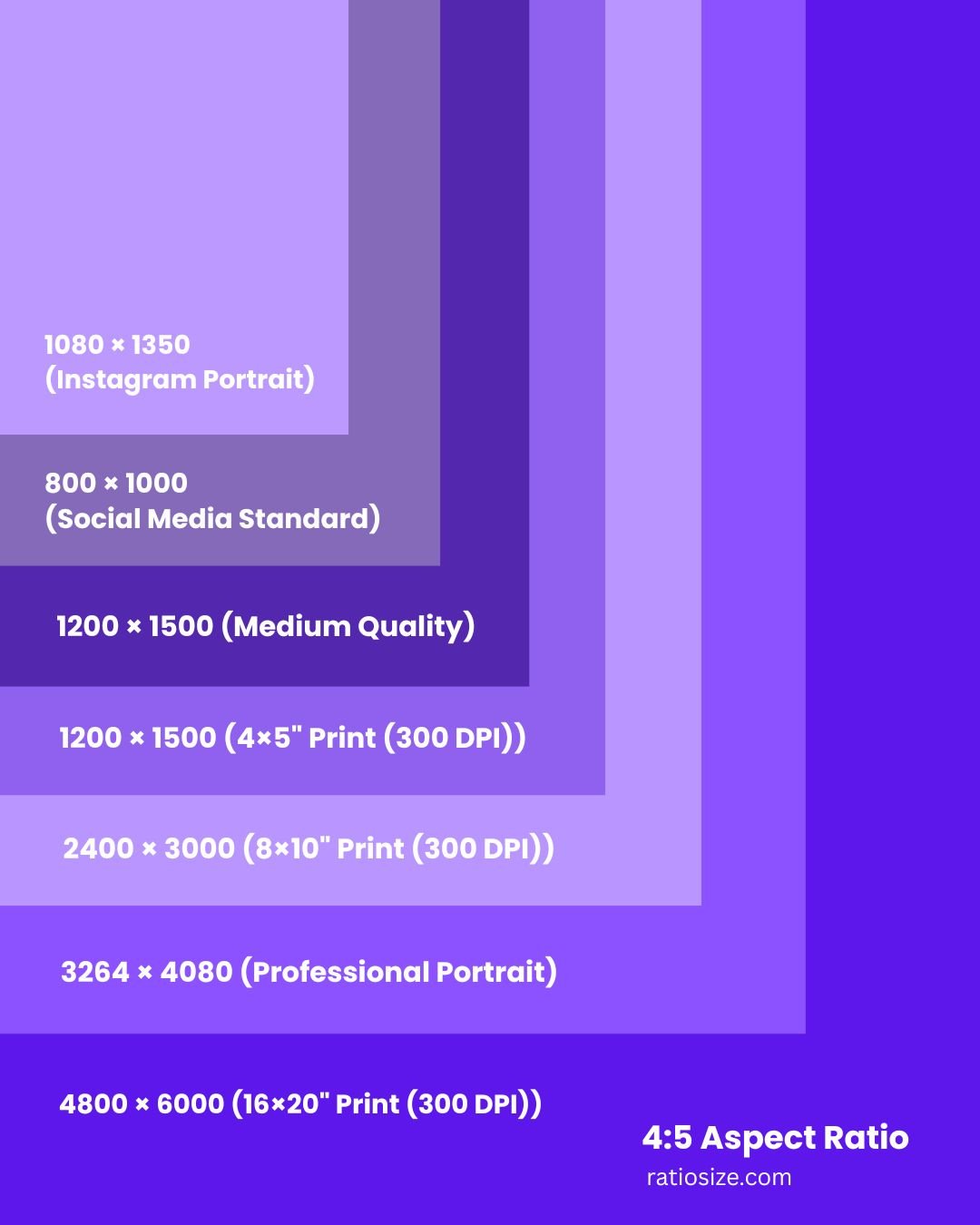
| Resolution Name | Dimensions (pixels) | Total Pixels | Common Uses |
|---|---|---|---|
| Instagram Portrait | 1080 × 1350 | 1,458,000 | Instagram feed posts, social media |
| Social Media Standard | 800 × 1000 | 800,000 | General social media sharing |
| Medium Quality | 1200 × 1500 | 1,800,000 | Digital display, online portfolios |
| 4×5" Print (300 DPI) | 1200 × 1500 | 1,800,000 | Small photo prints, contact sheets |
| 8×10" Print (300 DPI) | 2400 × 3000 | 7,200,000 | Standard portrait photo prints |
| Professional Portrait | 3264 × 4080 | 13,317,120 | High-quality portrait photography |
| 16×20" Print (300 DPI) | 4800 × 6000 | 28,800,000 | Large format prints, gallery displays |
Rise of the 4:5 Format in Digital Media
The 4:5 aspect ratio has gained prominence through several key developments:
- Instagram adoption: When Instagram expanded beyond its original square-only format in 2015, it established 4:5 as the maximum vertical extent for feed posts, instantly establishing this ratio as a social media standard.
- Mobile optimization: The moderate vertical format works well on mobile devices, allowing content to occupy more screen space than square posts without requiring excessive scrolling.
- Portrait photography: The 4:5 ratio provides a pleasing frame for portraiture, offering more headroom than a square while maintaining a balanced composition.
- Print compatibility: The 4:5 ratio closely matches the 8×10 inch standard print format, creating a harmonious transition between digital and physical media.
While the 9:16 ratio has become dominant for full-screen vertical experiences like Stories, the 4:5 format has established itself as the preferred option for vertical content that needs to exist within a scrollable feed environment.
4:5 in Social Media and Content Creation
For creators, the 4:5 format offers specific advantages:
- Maximized feed presence: On Instagram and other social platforms, 4:5 content occupies the maximum possible vertical space in feeds, creating greater visual impact while scrolling.
- Compositional flexibility: The moderate vertical extension provides more room for complex compositions than square formats without forcing extreme vertical arrangements.
- Subject emphasis: The slight vertical emphasis naturally draws attention to vertical subjects like people, buildings, and tall products.
- Cross-platform compatibility: The 4:5 ratio is generally well-accommodated across different social platforms, making it a safe choice for content intended for multiple distribution channels.
Creator's tip: When composing for 4:5, consider dividing your frame into three vertical sections for composition. This approach helps create balanced images that guide the viewer's eye from top to bottom in a natural progression.
4:5 in Photography
The 4:5 ratio has specific photographic applications:
- Portrait orientation: The moderate vertical extension makes 4:5 ideal for full-body or three-quarter portrait photography, providing adequate headroom without excessive space.
- Architectural photography: Taller buildings and vertical structures can be better accommodated in 4:5 than in wider formats or squares.
- Product photography: Vertical products like bottles, packaging, and fashion items display effectively in the 4:5 format.
- Large format inspiration: While not identical, the 4:5 ratio evokes the proportions of 4×5 large format film photography, which has a rich tradition in professional photography.
Photographer's tip: When shooting with 4:5 output in mind, leave some extra space around your subject if your camera doesn't have a 4:5 frame guide. This gives you flexibility to create the most effective crop in post-processing.
Converting Between 4:5 and Other Aspect Ratios
Adapting content to or from the 4:5 format requires careful consideration:
Converting from 4:5 to Square (1:1)
- Vertical crop method: Remove portions from the top and/or bottom of the 4:5 image to create a square.
- Subject focus: When cropping, prioritize keeping the main subject properly positioned within the new square frame.
- Mathematical conversion: For a 4:5 image with height H, the square (1:1) height would be H × (4÷5), or 0.8H.
Converting from 4:5 to 9:16
- Vertical extension: Add more content to the top and bottom, or extend the background/canvas.
- Center placement: Position the original 4:5 content in the center of the taller 9:16 frame with complementary elements or background above and below.
- Mathematical conversion: For a 4:5 image with width W, the 9:16 width would be W × (9÷16) × (4÷5), or approximately 0.45W.
Converting from Landscape Formats to 4:5
- Center crop: For subjects centered in the original frame, a center crop often works best.
- Subject-focused crop: For off-center compositions, position the 4:5 crop to best frame the main subject.
- Content extension: For critical content that cannot be cropped, consider extending the background vertically to achieve the 4:5 ratio.
Design consideration: When creating multi-format content, consider establishing a "safe area" in the center that will remain visible across all aspect ratios, placing crucial elements within this zone.
Technical Considerations for 4:5 Content
Platform-Specific Requirements
When publishing 4:5 content:
- Instagram specs: The platform automatically processes uploaded 4:5 content to 1080×1350 pixels, so maintaining this resolution or a multiple of it helps preserve quality.
- Compression impact: Vertical content can sometimes be more affected by compression algorithms than square content, so maintaining crisp edges and adequate contrast helps preserve quality.
- Text considerations: When adding text to 4:5 content, keep it within the central 80% of the frame for best visibility across platforms.
Print Considerations
For 4:5 content intended for print:
- 8×10 inch compatibility: The 4:5 ratio (which is equivalent to 8×10) is a standard photo print size, requiring no cropping when properly prepared.
- Print resolution: For high-quality physical prints, maintain a resolution of 300 DPI. This means an 8×10 inch print requires a 2400×3000 pixel image.
- Bleed area: When preparing 4:5 content for professional printing, add a 0.125-inch bleed area around all edges to accommodate trimming.
Future of the 4:5 Aspect Ratio
The 4:5 ratio's position in contemporary visual media:
- Social media standard: As long as Instagram maintains its 4:5 maximum for feed posts, this ratio will remain a content creation standard.
- Vertical content balance: The 4:5 ratio occupies a middle ground between square and full-vertical formats, making it likely to remain relevant regardless of platform-specific constraints.
- Print persistence: The relationship to standard print sizes ensures the 4:5 ratio will maintain relevance beyond digital applications.
- Composition teaching: As vertical content grows in importance, the 4:5 ratio serves as an accessible introduction to vertical composition techniques.
The 4:5 aspect ratio represents a pragmatic compromise between traditional photographic formats and modern digital constraints. While not as dramatic as full-screen vertical formats, its practical advantages and platform compatibility ensure its continued relevance in content creation.
Practical Applications and Tips
For Social Media Creators
- Use 4:5 to maximize feed presence without triggering cropping on major platforms
- When converting horizontal content to 4:5, focus on maintaining the integrity of the main subject
- Create templates in 4:5 format to ensure consistent vertical composition across your content
For Photographers
- Consider shooting slightly wider than your intended 4:5 crop to give yourself composition flexibility in post-processing
- For portrait photography, the 4:5 ratio provides ideal framing for three-quarter and full-body shots
- Use the natural vertical emphasis of 4:5 to draw attention to height and scale in architectural photography
For Print and Display
- Prepare 4:5 images at 300 DPI for optimal printing at 8×10 inches and related sizes
- When framing 4:5 prints, consider that standard pre-cut mats are readily available in this proportion
- For digital display, the moderate vertical format of 4:5 works well in slideshows and portfolios without excessive letterboxing
The 4:5 aspect ratio offers a versatile vertical format that balances compositional flexibility with practical platform constraints. By understanding its properties and applications, you can effectively leverage this ratio to create impactful vertical content that maintains visual presence while adapting seamlessly between digital and physical presentation formats.